Murals as Rhetoric
How Latin Americans use murals to resist marginalization
By Jesus Hernandez
Introduction
Welcome to this website, dedicated to exploring the challenges faced by Latin American communities, as well as the ways that these communities resist and overcome marginalization using murals!
Public space in the United States is often shaped by institutions that decide what stories belong on walls, whose histories are celebrated, and whose voices remain invisible. Yet across the country, Latin American communities transform these same spaces into open-air archives of memory and resistance. Murals become more than decoration; they function as arguments. They resist marginalization, and assert presence in places that have historically marginalized them.
This project explores how communities use public art, specifically murals, as a nontraditional rhetorical medium. Unlike newspapers, politics, or mainstream entertainment platforms, murals exist outside the typical mediums of communication. They typically don't have editors stating what can or cannot be shown, and thus cannot be systematically supressed. Since murals occupy the physical landscape, they essentially catch the attention of everyone who passes through the area.
Following Marshall McLuhan's idea that “the medium is the message,” murals demonstrate rhetoric because of the form they take. Painting on freeway pillars, train stations, or neighborhood walls changes who gets to speak in public space. These environments carry their own symbolic language: permanence, visibility, locality, risk.
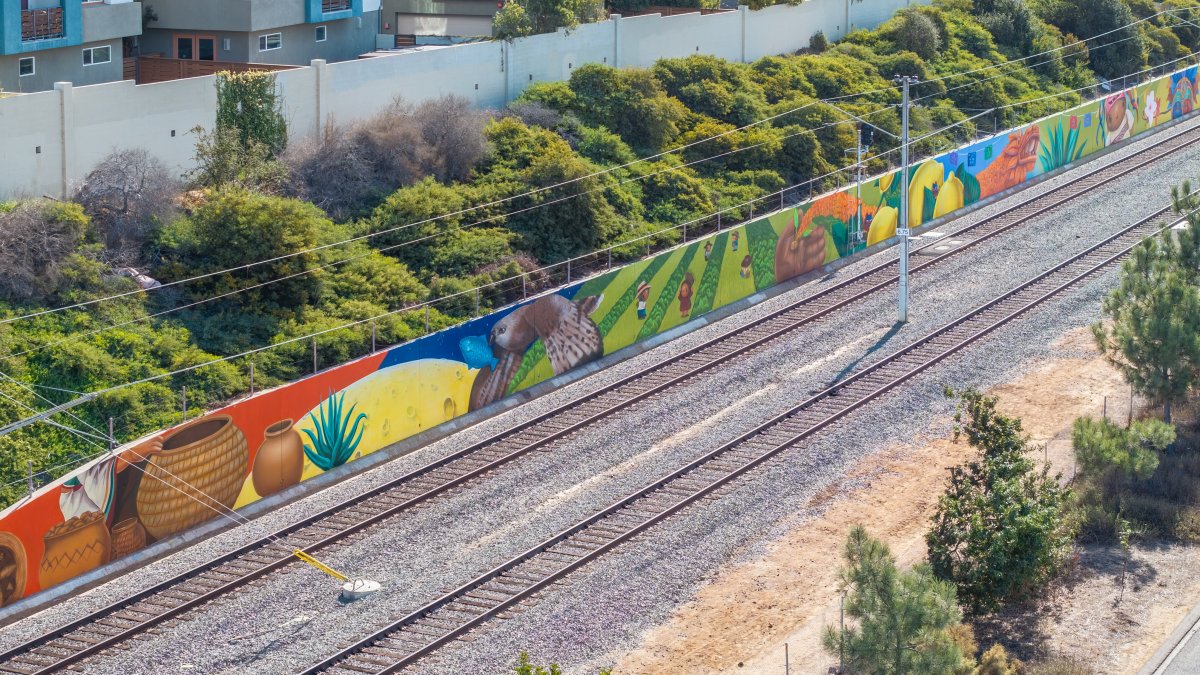
This site highlights three examples of public art created by Latin American communities in the U.S., and analyzes how each uses visual rhetoric to resist dominant narratives by those in power. When they're all put together, they reveal a pretty similar pattern of cultural resistance: a form of communication grounded in community rather than corporate or political platforms such as Twitter.
Positioning Myself
As a first generation college student of Mexican descent who has spent nearly my entire life in San Diego, I honestly see these murals as elements of my everyday environment. Public transit is my primary mode of transportation, including both busses and trolley, so the MTS trolley murals form part of the visual landscape whenever I take a ride to school, work, or home. In contrast to the high-end architecture in downtown San Diego and “fancy” buildings that seem to look intended for high income individuals, these murals make public space feel more like... home. They represent histories, aesthetics, and identities that align with my own background and remind me that people like me are not only present, but acknowledged. In that sense, the murals function as a subtle affirmation that I belong in the city I live in.
Studying these murals through McLuhan and Doctorow, as well as through concepts like the Overton Window, has made me more aware of how significant it is that this form of presence shows up as a nontraditional medium. I usually learn about marginalized communities in classrooms, through assignments, or on social media feeds that are structured by institutional or algorithmic rules. Murals simply feel quite a lot different. They are less bound by those rules and almost impossible to ignore because of their scale and placement. For me, that difference matters because it illustrates how marginalized communities in San Diego turn to alternative media when conventional platforms do not fully recognize them. The murals I pass on the trolley are not only pieces of art, they are also reminders that my experiences are part of a larger community. They remind me that I am not alone here, and that I can resist marginalization with the help of my community.